 Clearwater Siding
 Board & Batten Siding Built for Belleair's Coastal Exposure
Belleair sits on a narrow strip of Pinellas County between Clearwater Harbor and the Gulf of Mexico, which means homes here take on a version of Florida weather that inland neighborhoods simply don't see. Hurricane-force wind gusts, near-constant UV exposure, wind-driven rain that gets pushed sideways into wall assemblies, and salt air that never really lets up — all of it works on a home's exterior every single day, not just during storm season. Board and batten siding, with its crisp vertical lines and strong shadow lines, is a popular choice for Belleair homes because of how it looks. But in this location, how it's built matters just as much as how it looks.
This page is about one service in one place: board and batten siding installation for homes in and around Belleair. We're a Clearwater-based crew that already works this stretch of Pinellas County, and we install James Hardie fiber cement exclusively — no vinyl, no wood, no LP SmartSide. Below is what that actually means for a Belleair home, and why the details of the install matter more here than almost anywhere else in the state.
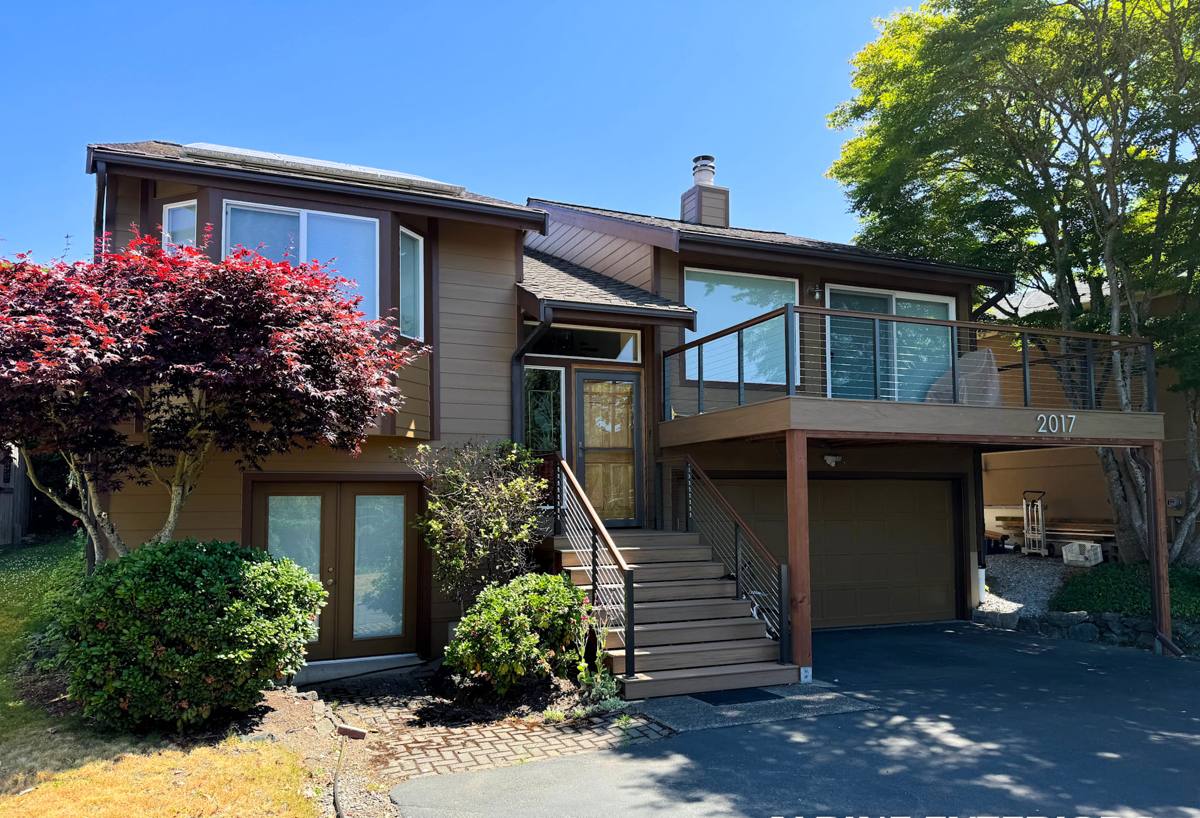
Why Board & Batten Fits Belleair's Homes
Belleair's residential character mixes older coastal cottages, Florida vernacular homes, and newer construction built to more current wind codes. Board and batten reads well against all three. The vertical board pattern, capped by narrow battens over each seam, gives a home a taller, more tailored look than standard lap siding, and it pairs naturally with gable ends, dormers, and covered porch accents that are common on this part of the coast. Many homeowners use it as a full exterior treatment; just as many use it as an accent — a gable, a bay window surround, an entry feature — paired with horizontal lap siding on the rest of the house.
Either way, the appeal is the same: strong vertical lines, deep shadow relief, and a look that doesn't get lost against Gulf light. The tradeoff is that a vertical siding profile has more seams, more butt joints, and more places where water and wind can find a way in if the installation isn't done correctly — which is exactly where the climate here becomes the deciding factor.
What Belleair's Climate Does to Vertical Siding
Hurricane-Force Wind Loads
Belleair's proximity to open water means design wind speeds here run higher than in inland Pinellas County. Vertical siding has more individual pieces and more fastening points than lap siding, so fastener type, fastener spacing, and blocking behind every seam all directly affect whether a board and batten wall performs in a storm or peels away from the sheathing.
Year-Round UV Exposure
Florida's sun doesn't take a season off, and board and batten's vertical boards catch direct sun differently than horizontal lap does — full sun on wide, flat faces for most of the day. Paint-grade wood and unfinished composite products chalk, fade, and start showing UV breakdown faster under this kind of exposure. A factory-applied finish engineered to resist UV, rather than a field-applied paint job, holds color and film integrity much longer.
Wind-Driven Rain
Storms here rarely arrive as straight-down rain. Wind pushes water sideways and upward into every seam, joint, and batten overlap on a vertical wall. That means the water management behind the siding — the weather-resistive barrier, the flashing at every horizontal transition, and the drainage plane behind the boards — has to be right, because the siding itself is not the only thing keeping water out.
Salt Air and Corrosion
Living this close to the Gulf means airborne salt settles on every exterior surface, including fasteners. Standard fasteners corrode faster in this environment, and corroding fasteners in a vertical siding assembly are a slow-motion failure point — streaking, staining, and eventually a loosened board. Fastener spec is not a place to cut corners on a Belleair job.
Why We Install Only James Hardie Board & Batten
We standardized on James Hardie fiber cement, and we don't install vinyl, LP SmartSide, primed spruce, cedar, or other cement-fiber brands. That's a deliberate call, not a sales position, and it's worth explaining honestly rather than just asserting it.
Wood board and batten looks great on day one. The problem in a coastal climate is long-term moisture behavior — wood swells, cups, and rots at end grain and joints, and keeping it sealed against wind-driven rain and salt-laden humidity means a repainting and recaulking cycle that never really stops. Vinyl board and batten is low-maintenance in one sense, but it's a thin plastic panel with real limits: it deforms in high heat, it can crack or blow off in sustained high wind if not rated and installed correctly, and it can't be painted a different color down the road without replacing it. Both are legitimate products elsewhere. In a wind-driven, salt-air, high-UV environment like Belleair's, we don't think either is the right long-term bet, so we don't install them.
James Hardie's fiber cement is non-combustible, doesn't rot, and is engineered specifically for humid, moisture-heavy climates through its HZ5 product formulation — the version built for the Southeast. It carries a factory-applied ColorPlus finish baked on under controlled conditions, which holds up to UV and salt air far better than field-applied paint, and it comes with a strong transferable warranty backing the product itself. It's also heavier and more rigid than vinyl, which matters directly for wind performance once it's properly fastened to code.
James Hardie vs. Wood and Vinyl Board & Batten
| Factor | James Hardie Fiber Cement | Wood | Vinyl |
|---|---|---|---|
| Moisture / rot resistance | Engineered for humid climates (HZ5) | Prone to rot, swelling, cupping | Won't rot, but seams can trap moisture |
| Wind performance (properly installed) | Rigid, heavy, rated for high wind zones | Depends on fastening; degrades over time | Lighter panel, more prone to flex and blow-off |
| UV / color retention | Factory ColorPlus finish resists fading | Field paint fades, needs repainting | Can fade and chalk; can't be repainted easily |
| Fire resistance | Non-combustible | Combustible | Softens/deforms under heat |
| Warranty | Strong transferable manufacturer warranty | Typically none on the material itself | Varies widely by manufacturer |
What a Correct Board & Batten Installation Involves
Board and batten is less forgiving of shortcuts than lap siding, because every vertical seam is a potential water path and every batten strip is a fastening decision. On a Belleair home, we treat the following as non-negotiable:
- A continuous weather-resistive barrier behind the siding, with all seams properly lapped and sealed
- A drainage plane or furring strategy so any moisture that does get behind the boards can drain and dry out
- Flashing at every horizontal transition — window and door heads, roof-to-wall intersections, and trim bands
- Fastener spacing and fastener type matched to the local wind zone, not a generic minimum
- Corrosion-resistant fasteners appropriate for salt-air exposure
- Correct board and batten overlap and gap spacing per manufacturer specification, not eyeballed
- Sealed, primed cut ends at every joint, corner, and penetration
- Manufacturer-specified clearance at the base of the wall and above roof lines to keep siding out of standing water and debris
Skip any one of these and the siding can still look right for a while — the failures in a board and batten wall tend to show up as streaking, staining, or a soft spot years later, not on installation day.
Our Process for Belleair Homeowners
We already work this part of the Clearwater/Pinellas County coastline, which matters for a few practical reasons. Homes near Belleair are typically built to reflect the higher wind-speed design requirements common to Gulf-front and near-coast locations in the county, and permitting reflects that — inspectors here are used to seeing the fastening schedules, flashing details, and product documentation that go with a compliant James Hardie install, and we pull permits and build to those specs as a matter of course, not as a special request.
A typical project starts with an on-site look at the existing wall assembly — what's under the current siding, what shape the sheathing and framing are in, and whether we're doing a full tear-off or working with an area that's already down to sheathing. From there we walk through board and batten layout with the homeowner (spacing, reveal, where it meets existing lap siding or trim), confirm color and product line, and schedule the install. Because we're local, punch-list items and warranty follow-up don't mean waiting on a crew that has to drive in from across the bay.
Cost Factors for Belleair Board & Batten Projects
Every home is different, so we don't publish flat per-square-foot pricing — but these are the variables that actually move the number on a Belleair job:
| Factor | Why it affects cost |
|---|---|
| Full re-side vs. accent application | Whole-house board and batten costs more than using it as a gable or feature accent |
| Tear-off vs. new construction | Removing and disposing of existing siding adds labor beyond the install itself |
| Substrate condition | Rotted sheathing or framing found during tear-off requires repair before siding goes on |
| Wall height and roofline complexity | Gables, dormers, and multi-story walls add cutting, scaffolding, and labor time |
| Trim and accessory detail | Corner boards, window/door trim, and batten spacing custom work add time |
| Color and finish selection | ColorPlus factory finish options vary in price versus primed-for-paint product |
Maintenance in a Coastal Environment
James Hardie board and batten with a ColorPlus finish is genuinely low-maintenance compared to wood, but "low-maintenance" doesn't mean "no maintenance" this close to the Gulf. Salt residue and airborne grime build up on any exterior surface here, so an occasional gentle rinse keeps the finish looking like it should. After any significant storm, it's worth a visual check for loose battens, cracked caulk joints, or debris impact — catching a small issue early is a lot cheaper than dealing with water intrusion behind the wall six months later. Because the ColorPlus finish is factory-applied and baked on, homeowners aren't stuck on a repainting cycle the way they would be with wood board and batten, which is one of the bigger practical differences over the life of the siding.
If you're considering board and batten siding for a home in Belleair, we're glad to come take a look, walk the exterior with you, and give you a straight, no-pressure estimate based on your home's actual condition — not a generic quote. Use the form below to get started.